|
Simple principles
… that work
The basic principle
used by the Goatley transmission involves the utilization of small
multiple-clutch packs to engage the drive between a gear and the
shaft. Specially designed Goatley hubs replace the
traditional synchro-hubs and cones.

The most recent
prototypes, as in the demonstration saloon car, have been
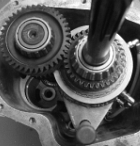
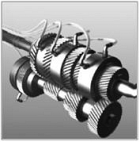
“Goatley-converted” conventional manual transmissions. The
externally splined main shaft is retained and the adaptor hub is
machined with an internal spline to engage conventionally on the
shaft allowing both to rotate together. The gears are not splined
and are able to freely rotate in relation to the shaft.
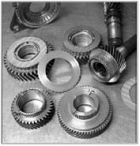
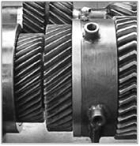
The adaptor hub
is designed and machined to provide annular recesses into which mini
multi-clutch packs and hydraulically actuated slave pistons are
fitted. The pistons are supplied with hydraulic fluid through the
transmission casing via passages provided in the hub.
Each clutch pack
comprises a series of annular steel plates interleaved
alternatively with a series of annular clutch plates. The steel
plates are formed with dogs or teeth which engage in the hub and the
clutch plates are formed with splines that engage to the teeth of
the gears. In this way, the clutch plates are alternatively fixed
to the shaft and the gear. When pressure is applied to the clutch
pack, the plates lock together and provide drive. When the pressure
is released, drive to that gear ceases.
Ratio changes occur
when one gear is simultaneously engaged to the hub while another is
released. Coordination of the two movements results in an almost
instantaneous exchange of the ratios in use and does not require the
pressure on the shaft to be eased by an engine cut - with an
associated reduction in speed. In similar manner, gradual grip of
the 1st gear clutch pack can act as a conventional clutch
to facilitate a start. Disengagement of all clutch packs results in
neutral. Fluid pressure is typically provided by electro-hydraulic
or electro-pneumatic
accumulators and actuators together with
solenoid valves.
Driver operated or
automated control systems may be employed.
|